




Ancient Persia
The Allure of Ancient Persian Jewellery: A Dive into Achaemenid History
The rich legacy of ancient Persia sparkles with the timeless beauty of its jewellery. Travelling back to the era of the Achaemenid Empire, particularly between 490 and 479 BC, we are mesmerised by the intricate craftsmanship that characterised ancient Persian jewellery. Though their military campaigns to conquer Greece may have fallen short, the Persians triumphed in the realms of luxury, art, and design. Their jewellery, a brilliant reflection of their refined taste and skill, remains a lasting testament to their artistry.

Table of Contents
Luxury and Power in Ancient Persian Jewellery: Persia to Greece
Between 490 and 479 BC, the Persian Empire made several attempts to conquer mainland Greece, ultimately without success. In the eyes of many Greeks, their victory was seen as a triumph of simplicity and discipline over a ‘barbarian’ foe, supposedly weakened by indulgence in luxury. However, Persian luxury was anything but barbaric. It was a sophisticated display of power and prestige, carefully crafted to reflect the empire’s strength. The opulent court style not only left its mark on neighbouring Athens but also reached far beyond, even influencing the likes of Alexander the Great.
One of the most striking features of Persian craftsmanship was their remarkable jewellery. Known for its vibrant colours, these pieces often featured inlaid glass, enamels, and an array of precious gemstones such as lapis lazuli and carnelian. Animal motifs were a common theme, with intricate designs often showcasing fierce lions, their flowing manes brought to life through meticulously inlaid stones. Persian jewellery techniques were so influential that artisans beyond Persia’s borders adopted and adapted them, blending Persian craftsmanship with their own local styles and motifs.

The Balance of Ancient Persian Jewellery: Power and Aesthetic Beauty
The luxury of the Persian court went far beyond mere aesthetic indulgence. Every sumptuous carpet, intricately crafted piece of jewellery, and opulent banquet had a deeper purpose. These were strategic displays, carefully used to assert the empire’s dominance and cultural sophistication. Through their unrivalled wealth and artistic brilliance, the Persians made a powerful statement to both allies and adversaries: they were the heart of global civilisation, a beacon of refinement and power.
Though Persia had a distinct cultural identity, its luxury was a reflection of the diversity within its vast empire. From the Indus Valley to Egypt and Anatolia, various regions enriched the empire’s splendour. Silks from the East, lapis lazuli from the Afghan mountains, and cedarwood from the Levant—each contributed to the grandeur of the Persian court. It was a living tapestry, woven from the finest materials gathered from every corner of its expansive realm, showcasing the empire’s reach and the interconnectedness of its territories.
It speaks volumes about Persia’s cultural allure that even Athens, the birthplace of democracy and a frequent rival of the empire, could not resist the charm of Persian luxury. Athenian nobles, after encounters with Persian ambassadors or visits to the Persian court, returned with vivid stories of magnificent palaces, mesmerising gardens, and lavish feasts that seemed to stretch on forever. Despite their political differences, Athens found itself enchanted by the splendour of Persian life.
The influence of Persian luxury extended far beyond Athens. Even Alexander the Great, despite his conquest of Persia, was captivated by its splendour. So much so that he adopted many Persian court customs, from wearing royal Persian garments to embracing their ceremonial practices. His court became a fascinating blend of Macedonian and Persian traditions, a fusion of his homeland’s customs with the opulence and grandeur of the Persian Empire he had once sought to overthrow.
Top 10 Iconic Ancient Persian Jewelleries from 550-300 BC


1. Ceremonial Gold Sword Sheath (5th Century BC, Achaemenid Period)
This breathtaking ceremonial sword sheath, made from embossed gold, offers a stunning glimpse into the artistry of the Achaemenid Empire. Likely originating in the 5th century BC, it was designed to cover a narrow leather scabbard, and its intricate scenes reflect the grandeur and precision of Persian craftsmanship. The sheath is adorned with a vivid hunting scene, featuring two Persian riders, wearing flowing gowns and tall headdresses, battling lions. The symmetry and detail are remarkable—the lions, horses, and riders are all finely rendered, with decorative borders framing the action.

The upper section of the sheath features a lion being struck by spears from the mounted figures, under a winged disc, a symbol of divine protection in Persian iconography. The lower sections are equally mesmerising, depicting coiling serpentine figures and more lions, symbolising strength and power. The attention to detail extends to the riders’ saddlecloths, fringed and decorated with tiny punched circles, while a series of galloping riders shooting arrows at lions fills the narrow length of the sheath.


This scabbard is a statement of Persian nobility and power, displaying a mastery of design and technique. Although influenced by a range of cultures—Scythian, Median, and even Assyrian—this piece is quintessentially Persian, blending local and foreign styles into a single, elegant work. Whether worn at ceremonial events or displayed as a symbol of prestige, this sheath reflects the Achaemenid Empire’s command of luxury and craftsmanship.
2. Gold Gorytus Fitting (5th–4th Century BC, Scythian Influence)
This elegant gold fitting, shaped like a stylised bird’s head with a curved beak and coiled, serpentine neck, highlights the sophisticated blend of Persian and Scythian artistry. Likely dating from the 5th to 4th century BC, this cut-out plaque was used to adorn a gorytus—a type of bow case—as suggested by similar designs seen on the famous Persepolis reliefs. Crafted in an openwork style, the plaque features five loops on the back, indicating it was once attached to cloth or leather, probably decorating the top of the bow case.

The design is a striking example of Persian adaptability, incorporating motifs from Scythian art, where stylised bird heads, with their pronounced eyes and sharp beaks, were common. In Persian culture, the bird motif often symbolised power, freedom, and divine favour, making it an ideal decoration for an item associated with archery, a skill deeply valued in both Persian and Scythian traditions.

This fusion of cultural influences—Persian craftsmanship and Scythian motifs—underscores the vast reach of the Persian Empire and its ability to absorb and refine the artistic traditions of the territories under its control. The gorytus fitting stands as a testament to the empire’s eye for detail, where even functional items like bow cases were crafted with precision and an eye for beauty.
3. Gold-Plated Hair Ornaments with Griffin Heads (450–400 BC, Cypro-Classical Period)
This striking pair of gold-plated bronze spirals, likely used as hair ornaments, offers a perfect blend of artistic elegance and mythical symbolism. Originating from ancient Cyprus during the Cypro-Classical period (450–400 BC), these pieces are adorned with the fierce heads of horned griffins, mythical creatures often associated with power, protection, and divine guardianship. The spiral design would have allowed the ornaments to be carefully threaded into the wearer’s hair, securing an elaborate and majestic look.

Each griffin head is attached to the spiral by a collar, which is beautifully decorated with a rosette at the front, a common motif in ancient jewellery symbolising beauty and the cycle of life. The collars and rosettes are partly inlaid with enamel, adding colour and detail to the otherwise gleaming gold-plated surface. The delicate craftsmanship, combined with the mythical imagery, reflects both the influence of Persian culture on the island of Cyprus and the island’s own rich artistic tradition.
These hair ornaments demonstrate the extensive reach of Persian luxury, influencing not only mainland cultures but also the islands that lay along its vast trade routes. The use of griffins—a common figure in both Persian and Greek art—further illustrates the fusion of cultural symbols, making these pieces both exotic and familiar, and a clear testament to the interconnectedness of the ancient world.
4. Achaemenid Gold and Pearl Pendant Necklace (5th–4th Century BC)
This delicate string of beads, dating from the 5th to 4th century BC, is a fine example of Achaemenid jewellery craftsmanship. Found in Pasargadae, the ancient capital of the Achaemenid Empire, the necklace features a stunning combination of pearls and gold spacer beads, with a single bell-shaped gold pendant serving as the centrepiece. The gold pendant, exquisitely crafted, adds an elegant touch to the necklace, which would have been worn by a high-ranking individual, symbolising both wealth and status.
The inclusion of pearls, likely sourced from the booming Persian Gulf pearl-fisheries of the time, highlights the Persian Empire’s extensive trade network. Pearls were a rare and highly prized luxury in the ancient world, and their presence in this piece speaks to Persia’s ability to draw upon resources from its vast territories and beyond. The mix of gold and pearls reflects the Achaemenid love for combining opulence with natural beauty, resulting in a refined yet understated piece of jewellery.
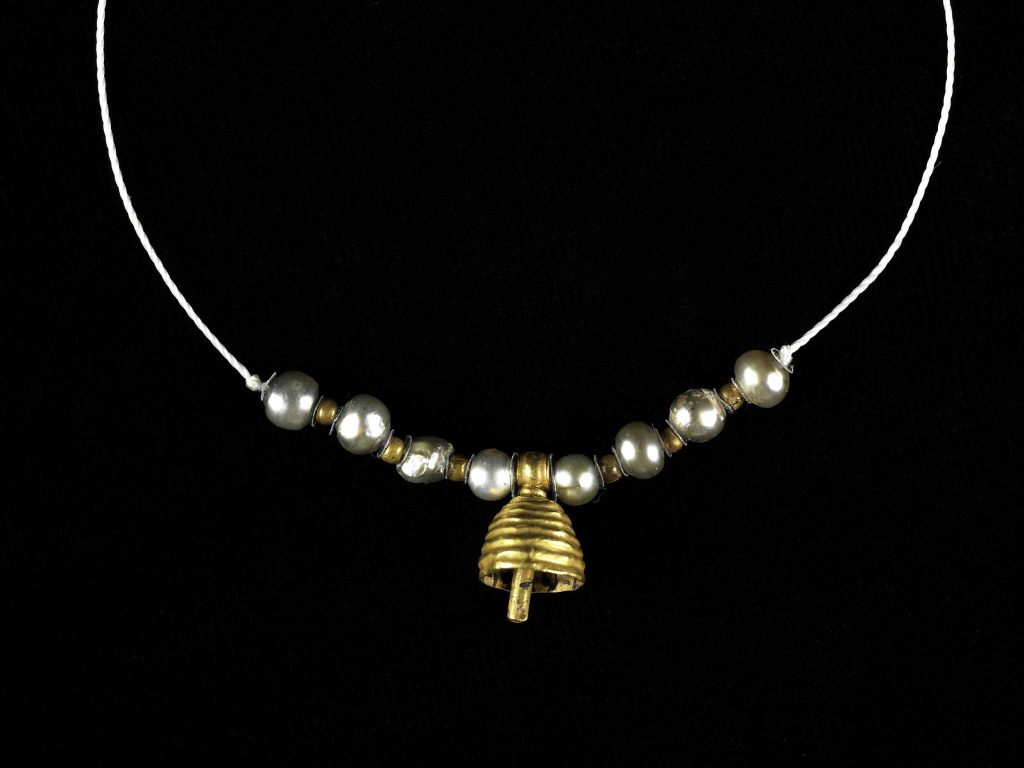
This pendant necklace not only demonstrates the artistic skill of Achaemenid jewellers but also serves as a reminder of the wealth and sophistication of the Persian court. The use of pearls, particularly from the Persian Gulf, underscores Persia’s role as a hub of trade and luxury in the ancient world, with its artisans transforming rare materials into timeless works of art.
5. Crescent-Shaped Gold Pectoral with Tree of Life Motif (6th–5th Century BC)
This magnificent crescent-shaped pectoral, crafted in gold, showcases the exceptional artistry of ancient Persian jewellers from the 6th to 5th centuries BC. Adorned with stylised bird figures at either end and a central display of three Tree of Life motifs, this piece is a beautiful example of symbolic and ornamental craftsmanship. The Tree of Life, edged with a narrow band of triangles above and below, holds great significance in ancient Persian art, symbolising fertility, renewal, and the eternal cycle of life. Its roots in Urartian art are unmistakable, but similar motifs also appear in the grand reliefs at Persepolis, reflecting Persia’s ability to incorporate and elevate motifs from neighbouring cultures.

Below the Tree of Life, a floral band featuring alternating lotus flowers and buds adds further elegance to the design. The lotus, often associated with purity and divine beauty in Persian and neighbouring cultures, further enhances the pectoral’s symbolic richness. The ornamentation, with its intricate details and meaningful motifs, highlights the wearer’s connection to divine protection and prosperity.
This pectoral, found in Armavir, is a marvellous example of the grandeur of ancient Persian jewellery, designed to communicate status, wealth, and spiritual significance. Its craftsmanship reflects the Persian Empire’s sophisticated culture, where beauty and meaning were seamlessly interwoven into every piece of art.
6. Gold Spiral Armlet with Lion-Head Terminals (5th–4th Century BC, Oxus Treasure)
This stunning gold armlet, possibly a torc, is one of the most iconic pieces from the renowned Oxus Treasure, dating from the 5th to 4th century BC. The armlet features a beautifully ribbed spiral design, culminating in two roaring lion heads at each terminal. The lions, symbolic of strength and royal authority in Persian art, are intricately detailed, with their manes brought to life by finely inlaid stones. The attention to detail continues with the lions’ necks, which are adorned with tiny cloisons—a delicate form of decoration using compartments filled with enamel or stones, though only fragments of these inlays remain.
The larger cells along the armlet’s surface, once filled with vibrant stones or enamel, showcase the jeweller’s masterful technique. Arranged on either side of a central ridge, these cells form an exquisite pattern that draws the eye along the length of the armlet. At the ends, volutes—a decorative spiral motif—enhance the fluid elegance of the piece.

Lions were a common motif in Achaemenid art, often symbolising power, protection, and guardianship. This armlet not only served as an accessory but also as a visual representation of the wearer’s status and strength, connecting them with the royal imagery that was central to Persian identity. The skillfull combination of ribbed gold and inlaid gemstones exemplifies the luxury and refinement of Achaemenid jewellery, with the armlet standing as a prime example of Persian mastery over metalwork and design.
7. Gold Lion-Griffin Plaque (5th–4th Century BC, Oxus Treasure)
This extraordinary gold plaque, likely used as a hair or cap ornament (aigrette), is a dazzling piece from the Oxus Treasure, showcasing a lion-griffin in a recumbent pose. Crafted with exquisite attention to detail, the mythical creature features bent legs, a curled tail ending in a leaf-like flourish, majestic wings, and straight horns complemented by long, pointed ears. The body of the lion-griffin is embossed and chased, with cavities on the flank and shoulder that would have once held inlays, adding vibrant colours to the otherwise golden surface.
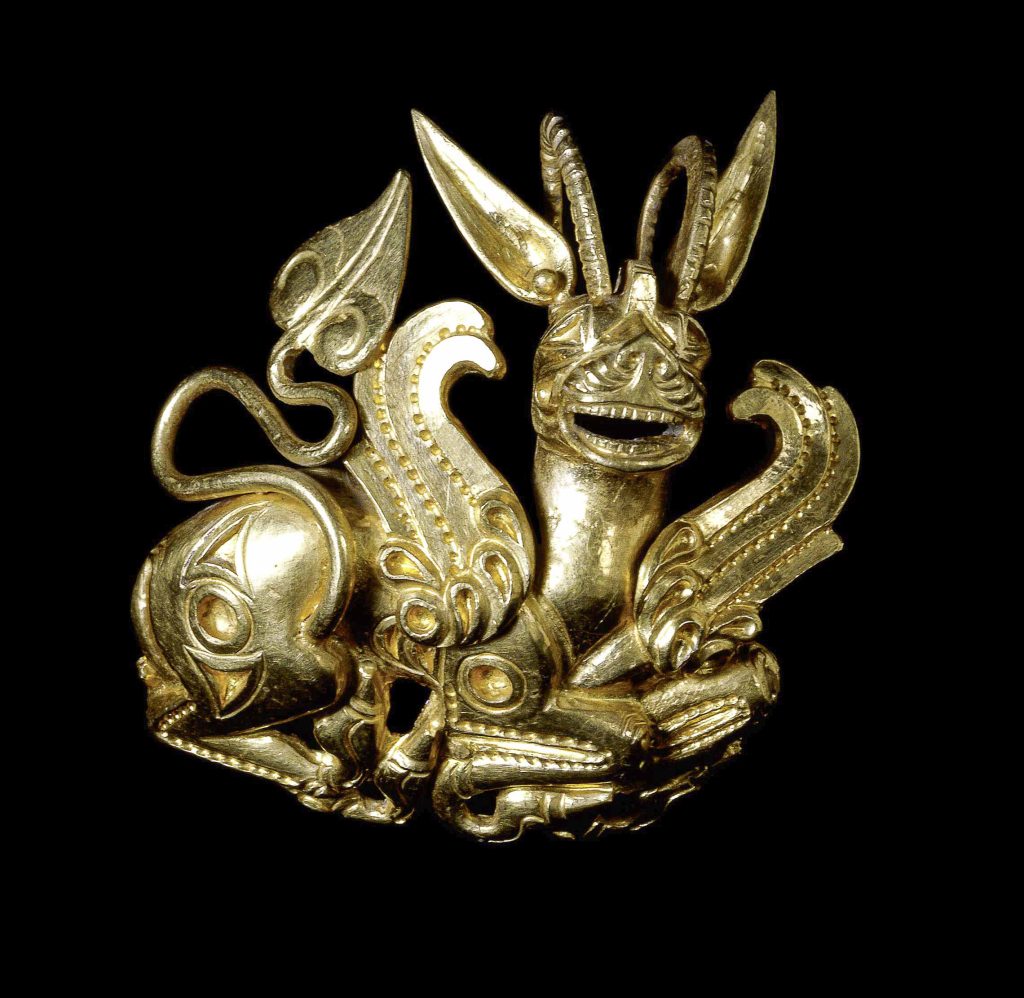
The combination of a lion and griffin, both symbols of power and protection, reflects the Achaemenid fascination with mythical creatures, blending elements from different cultural traditions. The influence of Scythian art is evident in the folded legs of the beast, reminiscent of designs found in Siberian tombs. Such cross-cultural influences were common in the Achaemenid Empire, where Persian artisans adopted and adapted motifs from across their vast territories.
At the back of the plaque, two long prongs suggest its use as a decorative piece, likely worn in the hair or attached to a cap, signifying the wearer’s elite status and connection to royal or divine imagery. The plaque’s compact yet intricate design, weighing over 43 grams, highlights the Achaemenid skill in creating powerful symbols of authority and protection through art.
8. Gold Roundel Fitting with Lion Motif (6th–4th Century BC, Achaemenid Period)
This exquisite gold roundel, crafted between the 6th and 4th centuries BC, features an intricate openwork design depicting two rampant lions within a circular frame. The lions, with their tails crossed and heads turned back to face each other, are iconic symbols in Persian art, representing strength, power, and protection. Although the head of the left lion is missing, the remaining details are a testament to the fine craftsmanship of Achaemenid jewellers.

The roundel was most likely used as a decorative fitting, stitched onto garments as an ornament. Such pieces were not only worn to showcase wealth and status but also to invoke the protective qualities that lions symbolised in Persian culture. The circular form, framing the dynamic lions, creates a sense of harmony and balance, further emphasising the mastery of Persian design.
This fitting, found in Iran, reflects the Achaemenid Empire’s love for both beauty and symbolism, where even the smallest accessories were rich with meaning. The lions, often seen in Achaemenid art and architecture, highlight the empire’s fascination with powerful animals, reinforcing the wearer’s connection to royal and divine strength.
9. Gold Disc Clothing Appliqué with Lion-Griffin (5th–4th Century BC, Oxus Treasure)
This gold disc appliqué, from the Oxus Treasure and dating to the 5th–4th century BC, features a beautifully embossed lion-griffin, a recurring symbol of power and protection in Persian art. The mythical creature is shown seated, facing right, with its head turned back in a strikingly graceful pose. The figure is enclosed by a ribbed border, adding an element of refinement to the design. This appliqué, likely used as an ornamental attachment for clothing, has four loops on the reverse, allowing it to be securely sewn onto garments.

The lion-griffin motif speaks to the Achaemenid Empire’s fascination with hybrid creatures, which symbolised both the strength of the lion and the vigilance of the eagle, blending the terrestrial and the divine. Such appliqués would have adorned the clothing of the elite, reinforcing the wearer’s status and connecting them with these protective, regal symbols.
This piece is a perfect example of how the Persians elevated even the smallest decorative items, ensuring that each element, whether functional or ornamental, carried the weight of symbolism and artistry. The meticulous detailing, along with the appliqué’s bold design, reflects the sophistication of Achaemenid jewellery-making techniques and their use of mythological imagery to convey power and prestige.
| 1. Sword sheath cover | Gold, found at Takht-i Kuwad, Tajikistan; 500-400 BC |
| 2. Decorative bow-case fitting | Gold, found at Takht-i Kuwad, Tajikistan; 500-330 BC |
| 3. Hair ornaments with griffin heads | Gold-plated bronze and enamel, found in a tomb at Amathus, Cyprus; 425-400 BC |
| 4. Necklace with pendant | Gold and pearl, Iran; 500-330 BC |
| 5. Pectoral with stylised birds | Gold, found at Armavir Hill, Armenia; 550-400 BC |
| 6. Spiral armlets | Gold, found at Takht-i Kuwad, Tajikistan; 500-330 BC |
| 7. Headdress ornament depicting a lion-griffin | Gold, found at Takht-i Kuwad, Tajikistan; 500-330 BC |
| 8. Roundel with two lions | Gold, found in Iran; 550-330 BC |
| 9. Ornament with seated lion-griffin | Gold, found at Takht-i Kuwad, Tajikistan; 550-330 BC |
| 10. Fitting depicting striding lion | Gold, found in Iran; 550-330 BC |
The Crown Jewel of Ancient Persian Craftsmanship: Gold Winged Griffin Armlet
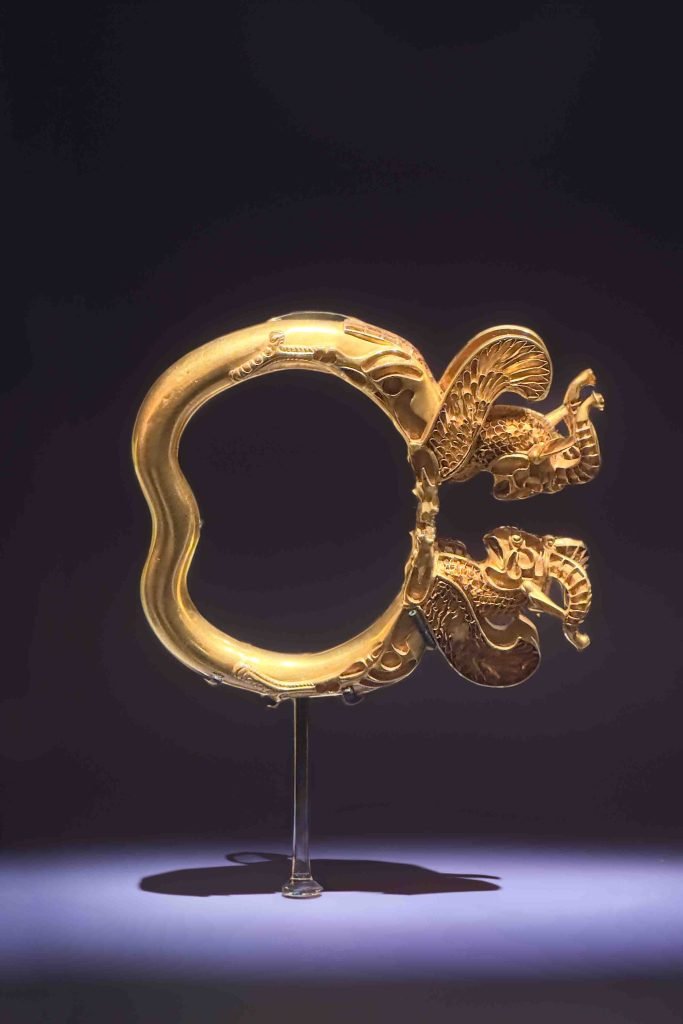
The Gold Winged Griffin Armlet from the Oxus Treasure stands as one of the finest examples of Achaemenid jewellery—a crown jewel of ancient Persian artistry. Crafted from solid gold and weighing nearly 400 grams, this armlet showcases the incredible skill of Persian goldsmiths and reflects the power and prestige of its wearer.
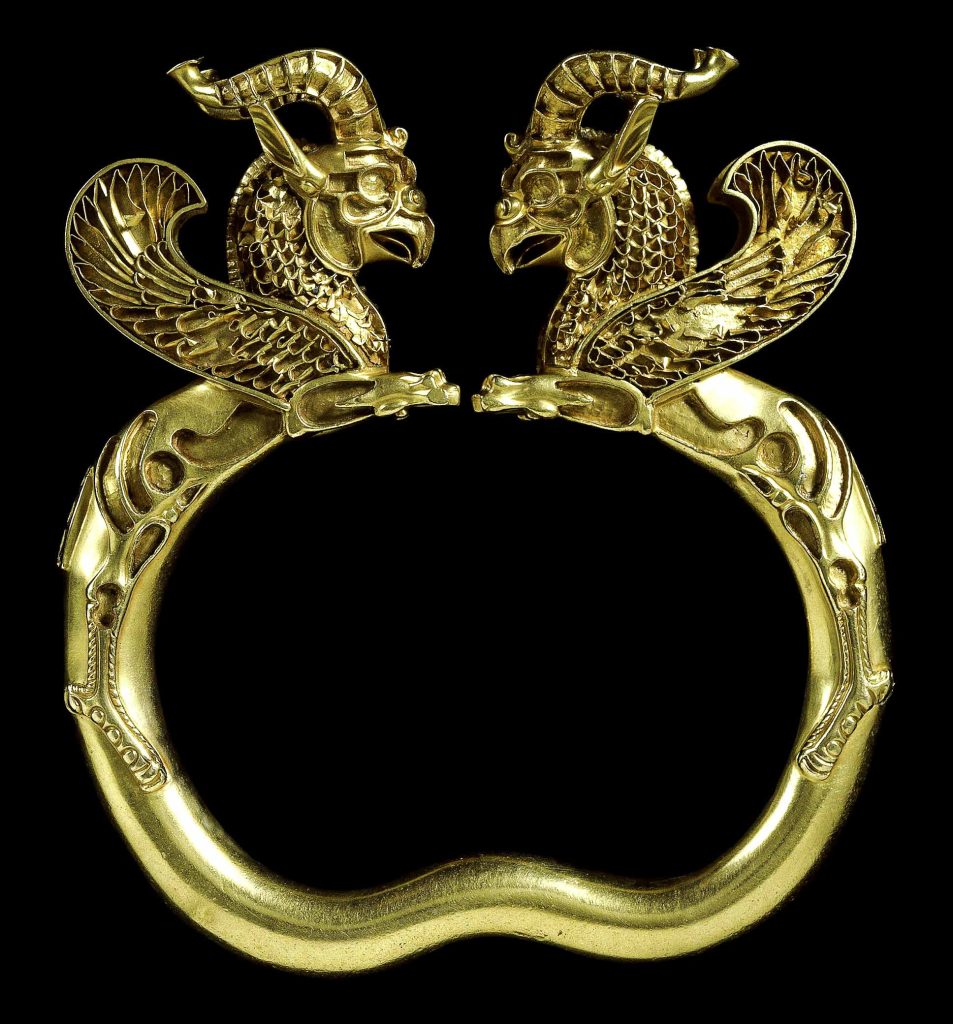
The armlet features two griffin-headed winged monsters at its terminals, symbolising strength and divine protection. Their detailed forms, with chased bodies and intricately chiselled horns, display a high level of craftsmanship. The necks, wings, and backs of the creatures are adorned with fine cloisonné cells, originally inlaid with colourful gemstones like lazulite. Though the inlays are now missing, the hollows hint at the vibrant beauty the armlet once held.
This armlet is one half of a pair, its counterpart housed in the Victoria and Albert Museum, reinforcing its status as a ceremonial piece, likely worn by royalty or high-ranking officials. The design and symbolism of the griffins—creatures linked to both protection and authority—suggest that this armlet was more than an ornament; it was a powerful statement of wealth, status, and divine favour.
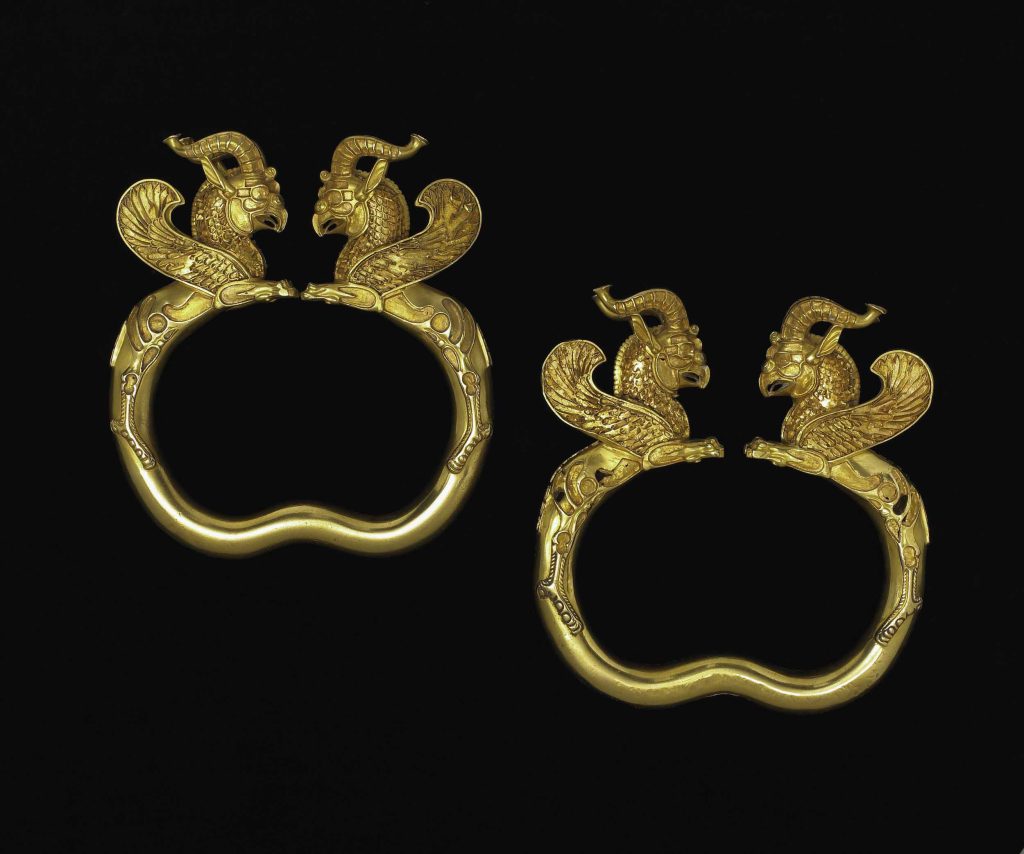
The Gold Winged Griffin Armlet is a stunning example of Achaemenid luxury, embodying the empire’s mastery in blending artistry with cultural symbolism. It remains one of the most significant pieces of ancient Persian jewellery, a true testament to the grandeur of the Achaemenid court.
Griffins and Lions in Ancient Persian Jewellery: Iconic Symbols of the Achaemenid Empire
Within the luxurious world of ancient Persian jewellery, two motifs stand out as symbols of power, protection, and prestige: the majestic lion and the mythical griffin. These iconic creatures were not merely decorative; they carried deep cultural significance, representing the strength, loyalty, and divine authority of the Achaemenid Empire. Their presence in Persian art, especially in jewellery, was a testament to the empire’s grandeur and its ability to convey its might through symbolic imagery.

The lion, often regarded as the king of animals, embodied courage, dominance, and nobility. It was a symbol of the empire’s earthly power and its ability to rule over vast territories with strength and authority. In contrast, the griffin, with the body of a lion and the head and wings of an eagle, symbolised protection, vigilance, and divine power. As a creature that bridged both land and sky, the griffin represented a connection between the mortal and divine realms, making it a fitting emblem for an empire that saw itself as divinely sanctioned.
In Achaemenid jewellery, these creatures were not mere adornments but statements of power and allegiance. When a courtier or noble wore a gold armlet adorned with griffin or lion motifs, it wasn’t just for aesthetic appeal—it was a public declaration of their status, loyalty, and connection to the ruling elite. Such symbols conveyed the wearer’s role within the empire’s complex hierarchy and their allegiance to the Achaemenid crown. This was especially true of high-ranking officials and satraps, whose jewellery often reflected their proximity to the imperial court and their right to wield power on behalf of the king.
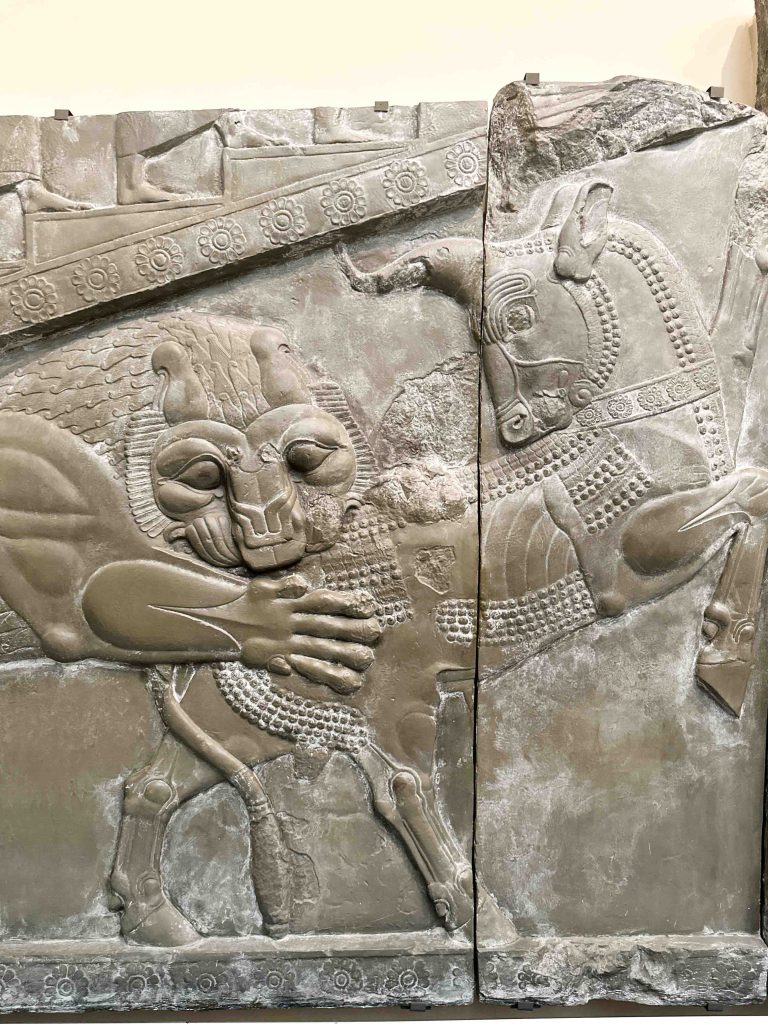
Beyond jewellery, lions and griffins were also integral to Persian art and architecture. They were carved into palace walls and featured prominently in ceremonial objects, textiles, and even weaponry. For example, the reliefs at Persepolis often depict these creatures in dynamic, protective poses, guarding the entrances to royal spaces or engaged in symbolic battles. Their presence was a constant reminder of the empire’s strength and divine protection, from the personal adornments of its elites to the monumental architecture that defined its cities.
Even today, these motifs endure as powerful symbols of the Achaemenid Empire’s legacy. The intricate depictions of lions and griffins in ancient Persian jewellery, such as gold armlets and plaques, offer a glimpse into the empire’s rich artistic and cultural traditions. They remind us that in Achaemenid Persia, jewellery was not just about ornamentation—it was a tool of communication, identity, and allegiance.
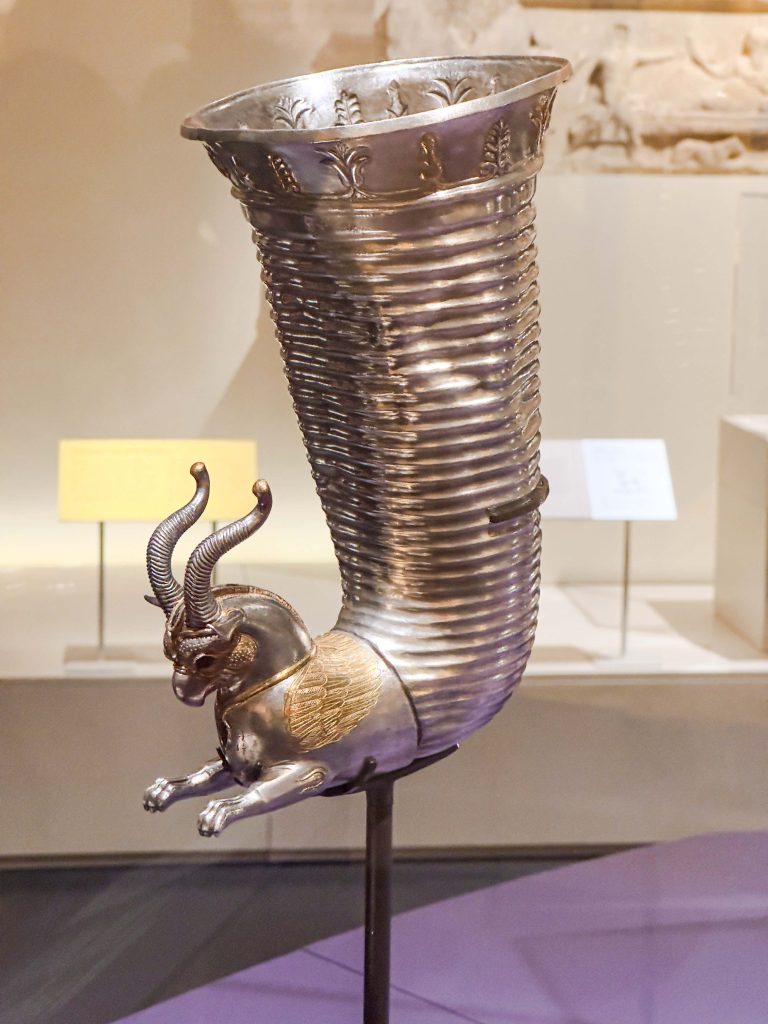
In essence, the lion and griffin were far more than artistic flourishes; they were emblems of an empire’s worldview. Through the lens of ancient Persian jewellery, these creatures continue to tell the story of an empire where art, symbolism, and power were inextricably linked, revealing a civilisation that understood the profound impact of imagery on cultural identity and imperial authority.
Conclusion: The Enduring Legacy of Ancient Persian Jewellery
Ancient Persian jewellery is a reflection of the vast cultural and symbolic richness of the Achaemenid Empire. From intricate gold armlets adorned with mythical griffins to finely crafted pendants and ceremonial scabbards, each piece tells a story of power, divine protection, and royal prestige. These ornaments were not simply decorative; they carried deep meanings, often reflecting the wearer’s status and loyalty to the empire.
The use of motifs like lions and griffins, so prominently featured in ancient Persian jewellery, underscores the importance of art as a vehicle for communication within the empire. Jewellery served as both a personal adornment and a symbol of identity, weaving together the values and narratives that defined one of history’s most influential civilisations. As we look back on these treasures today, their exquisite craftsmanship and profound symbolism offer a glimpse into the grandeur and sophistication of ancient Persia.
In the end, the enduring beauty of ancient Persian jewellery lies not only in its opulence but in the timeless stories it continues to tell about an empire that mastered the art of combining luxury with meaning. These pieces remain as powerful reminders of a civilisation that valued artistry, symbolism, and the ability to communicate through its creations.
About Craftestan
Having delved deep into the opulent world of Achaemenid Persia, we’ve witnessed the enduring allure of Persian artistry, especially in the realm of jewellery. But this artistic grandeur isn’t confined to the annals of history. Today, Craftestan emerges as a beacon, bridging the illustrious past with the present. More than just a brand, Craftestan is an embodiment of Persian craftsmanship’s heart and soul, deeply committed to the ethos of fair trade, sustainability, and empowerment of local artisans, especially the indomitable craftswomen from regions like Khorasan, Balochistan, and Azerbaijan in Iran.


The tales you’ve read today of ancient Persia resonate in every Craftestan creation. We invite you to continue your exploration and discover modern renditions of these historical marvels. Experience a curated blend of tradition and innovation with our handcrafted Persian jewellery collection. Feel the essence of the Achaemenid era while shopping for authentic, handcrafted treasures on Craftestan’s Persian jewellery Collection. Embrace a legacy that has thrived through millennia and still sparkles with unmatched elegance.


FQAs
What materials were commonly used in ancient Persian jewellery?
Ancient Persian jewellery was renowned for its opulence and craftsmanship, utilizing a variety of precious materials. Gold was the primary metal, prized for its beauty and malleability. Jewellers incorporated vibrant gemstones such as lapis lazuli, carnelian, and pearls. Inlaid glass and enamels added color and depth to the pieces. These materials were often sourced from across the vast Persian Empire, including silks from the East and cedarwood from the Levant, highlighting the empire’s extensive trade networks and access to luxury resources..
What is the significance of lion and griffin motifs in Persian jewellery?
Lions and griffins were iconic symbols in ancient Persian art and jewellery, representing power, protection, and royal authority. The lion symbolized strength and dominance, reflecting the empire’s earthly power. The griffin, a mythical creature with the body of a lion and the head and wings of an eagle, represented divine protection and the connection between the mortal and divine realms. Incorporating these motifs into jewellery was a way for wearers to express their status, allegiance, and connection to the ruling elite.
How did Persian jewellery influence other cultures of the time?
The luxury and artistry of Persian jewellery had a significant impact on neighboring cultures due to the Persian Empire’s vast reach and extensive trade networks. Greek artisans, for instance, were influenced by Persian motifs and techniques, especially after encounters during the Greco-Persian Wars. Athenian nobles and even Alexander the Great adopted Persian customs and incorporated Persian designs into their own art and jewellery. This cultural exchange led to a fusion of styles and the spread of Persian influence throughout the ancient world.
Where can I see examples of ancient Persian jewellery today?
Many exquisite pieces of ancient Persian jewellery are housed in major museums around the world. The British Museum in London holds the renowned Oxus Treasure, a significant collection of Achaemenid-period gold and silver artefacts, including jewellery. The Victoria and Albert Museum also features remarkable pieces, such as the Gold Winged Griffin Armlet. Museums in Iran, like the National Museum of Iran in Tehran, display extensive collections of ancient Persian art and jewellery, offering a direct connection to the country’s rich heritage.
What techniques did ancient Persian jewellers use in crafting their pieces?
Ancient Persian jewellers were masters of various sophisticated techniques. They employed embossing and chasing to create intricate designs on gold surfaces. Openwork and cloisonné (using compartments filled with enamel or gemstones) added complexity and color to their creations. Inlay work with precious stones and enamels was common, enhancing the visual appeal of motifs like lions and griffins. The combination of these techniques resulted in highly detailed and symbolic pieces that showcased both artistic skill and cultural significance.
Reference
Cawkwell, G. (2012). The Greek Wars : the Failure of Persia. Oxford: Oxford University Press.
Curtis, J., St John Simpson, British Museum and Iran Heritage Foundation (2010). The World of Achaemenid Persia : history, Art and Society in Iran and the Ancient near East. London: Tauris.
Curtis, J., Tallis, N., Béatrice André Salvini and Al, E. (2006). Forgotten Empire : the World of Ancient Persia. London: The British Museum Press.
Seyyed Hossein Nasr and Mehdi Amin Razavi (2008). An Anthology of Philosophy in Persia. London ; New York: I.B. Tauris Publishers.
Stoneman, R. and Yale University Press (2015). Xerxes : a Persian Life. New Haven ; London: Yale University Press.
Wiesehöfer, J. (2011). Ancient Persia : from 550 BC to 650 AD. London: Tauris.
Related Blog Posts


 Oil Painting
 Miniature Painting
 Wall Ornaments
 Enamel
 Filigree
 Turquoise
 Decorative Plate
 Home Accents
 Decorative Vase
 Pāteh
Pāteh Térméh
 Home Accents
 Mirror
 Tea ware & Tea
 Backgammon / Chess Board
 Home Accents
 Office
 Wall Clock
 Home Accents
 Vase
Vase Decorative Vase
 Wall Decor
 Home Accents
 Mirror
 Vase
Vase Embroidery
 Enamel
 Marquetry
 Watercolour Painting
 Under £20
 Under £50
 Under £100
 Under £200
 Under £300
 Mother’s Day
 Anniversary
 Her
Her Him
Him Ancient Persia
 Persian Artefacts
 Persian Clothing
 Persian Gift Ideas
 Oil Painting
I have been browsing online more thasn three hours
today, yet I never found any interesting article like yours.
It’s pretty worth enough for me. In mmy view, if all web owners and
bloggers made good content as you did, the web will be a lot more useful than ever
before.
Such an interesting read on Persian jewelry! The Achaemenid history behind these pieces adds so much depth and beauty to their allure.